
Duct Bank Spacers Guide

Duct Bank Spacers: Types, Sizing, and Installation Guide for Underground Conduit
Underground conduit systems carry power, controls, and communications between buildings, substations, and critical infrastructure. To keep those conduits aligned and protected inside concrete-encased duct banks, contractors rely on duct bank spacers. These structural supports maintain consistent spacing, protect conduits during the concrete pour, and help meet Code and inspection requirements.
This guide from Laird Plastics explains what duct bank spacers are, how they work, common types and sizes, recommended spacing guidelines, and best practices for installation across utility, industrial, transportation, and data center projects.
What Is a Duct Bank Spacer?
A duct bank spacer is a nonmetallic support used to maintain uniform horizontal and vertical separation between conduits inside a concrete-encased duct bank. The spacer holds each conduit in a fixed position, preventing movement or deformation as concrete is placed and cured.
Duct bank spacers are typically manufactured from:
- PVC – lightweight, corrosion-resistant, and cost-effective for most standard duct banks
- HDPE or composite materials – higher rigidity and stability for deep or heavily loaded banks
- Fiberglass-reinforced plastics – specialty projects requiring elevated mechanical performance
By using properly sized spacers, contractors can build multi-tier conduit banks that stay aligned from trench layout through final backfill.
Why Duct Bank Spacers Are Essential for Underground Conduit Systems
While it is technically possible to lay conduits directly in the trench, doing so creates major risks during installation and over the life of the system. Duct bank spacers solve several critical challenges:
- Prevent conduit deformation: Spacers lock conduits in place so they do not float, bow, or crush under the weight of wet concrete or backfill.
- Improve cable pulling performance: Uniform spacing helps conduits stay round and straight, reducing friction on power cables and fiber during pulls and future upgrades.
- Support NEC and AHJ compliance: Consistent separation and cover make it easier to meet Code requirements and pass inspections.
- Deliver long-term reliability: Proper alignment minimizes strain points and hot spots that can damage insulation or jackets over time.
- Save labor and rework: Spacer systems streamline layout and help crews install large conduit banks efficiently with repeatable results.
How Duct Bank Spacers Work
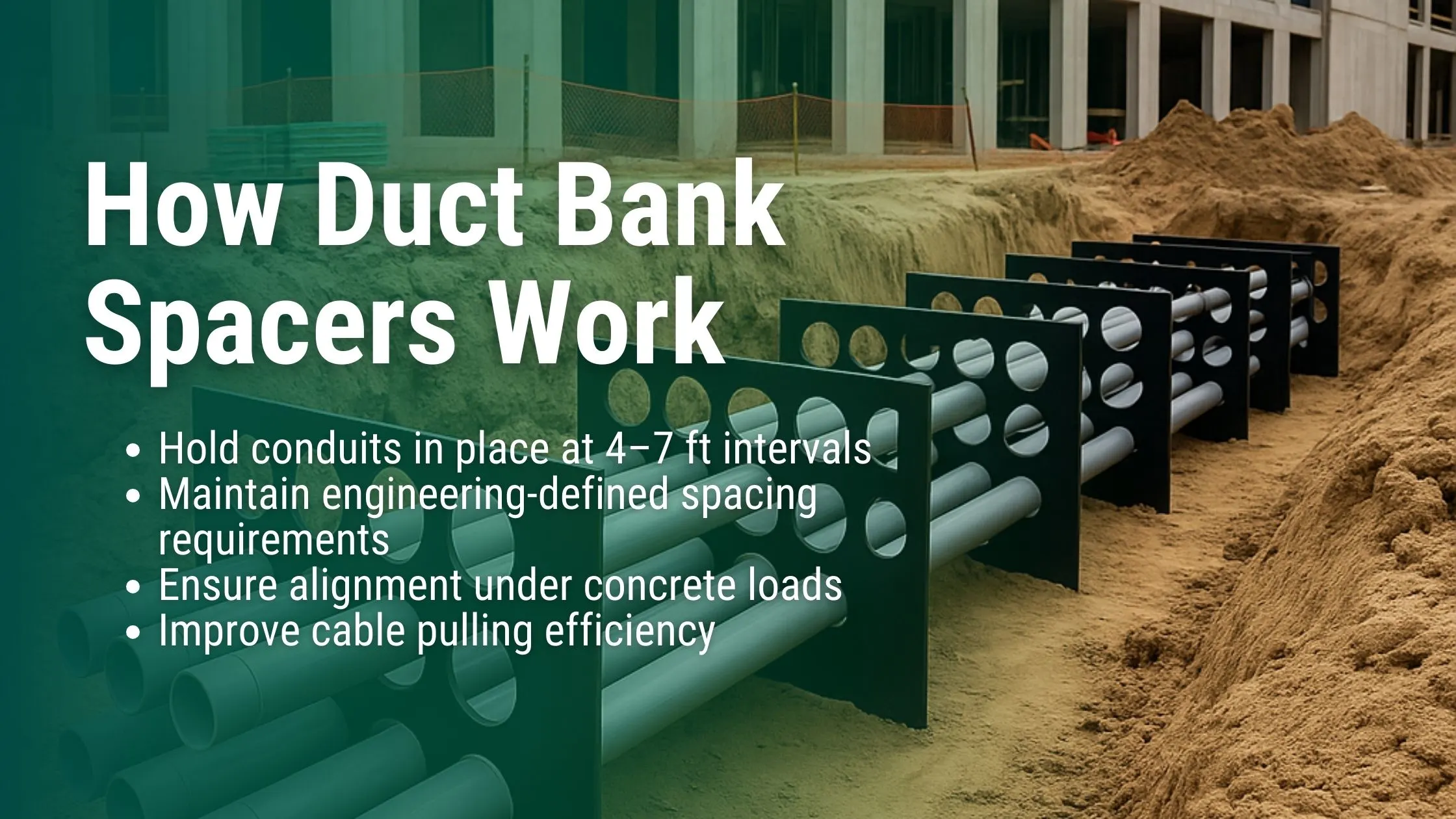
Duct bank spacers are placed at intervals along the trench to support conduits in a fixed pattern. Conduits are snapped into or rested within the spacer openings, which establish the horizontal and vertical spacing for each row and tier of the duct bank.
- Maintain center-to-center conduit spacing (commonly around 3 inches)
- Build multi-tier banks by stacking spacers vertically
- Hold conduit elevation and alignment before, during, and after the concrete pour
- Provide clearance to ensure the required concrete cover around each raceway
Types of Duct Bank Spacers
Selecting the right spacer design depends on conduit size, loading, project environment, and installation method. Laird Plastics offers several common spacer categories as well as custom options.
PVC Duct Bank Spacers
- Most widely used option for concrete-encased duct banks
- Lightweight and easy for crews to handle and position
- Non-corrosive and compatible with a wide range of soils and backfill materials
- Ideal for electrical, telecom, and general utility installations
HDPE & Composite Duct Bank Spacers
- Higher rigidity and dimensional stability than standard PVC
- Better suited for deep trenches or heavy concrete loads
- Useful in high-traffic corridors, industrial plants, and mission-critical facilities
Interlocking & Snap-Together Spacers
- Individual spacer pieces that interlock to create multi-cell arrays
- Allow flexible layout and easy field adjustment
- Commonly used where conduit patterns vary or expand over long runs
Multi-Tier & Multi-Cell Systems
- Pre-configured arrays supporting 4, 6, 9, 12, or more conduits
- Maintain vertical tiers in high-capacity duct banks
- Ideal for large power distribution, data center, and campus utility corridors
Custom Duct Bank Spacers from Laird Plastics
When standard spacers do not match your design, Laird Plastics can assist with custom-fabricated solutions, including:
- Non-standard conduit diameters or mixed-size banks
- Custom horizontal and vertical spacing dimensions
- Specialty materials for unique environmental or mechanical requirements
Duct Bank Spacer Sizes & Configurations
Spacer sizing is determined by the conduit diameter, number of conduits, and layout of the duct bank. Common configurations include:
- Single-tier spacers holding 2–6 conduits in one row
- Multi-tier assemblies stacking several rows vertically
- Cell sizes designed to accept common conduit diameters from 1 inch to 6 inches and larger
- Arrays structured for 4, 6, 9, 12, or more total conduits per spacer set
For complex corridor designs, Laird Plastics can help evaluate conduit sizes, quantity, and clearances to recommend an appropriate spacer style and configuration.
Recommended Spacer Placement & Spacing Guidelines
Spacer placement should always be based on project specifications and engineering direction. However, several rules of thumb are common across many underground duct bank installations.
Typical Spacer Interval
Duct bank spacers are typically installed every 4 to 7 feet along the length of the trench. Closer spacing is often used for larger conduits, deeper trenches, or areas with unstable soil.
Horizontal & Vertical Separation
- Common center-to-center spacing between conduits is around 3 inches.
- Vertical spacing is selected to allow enough concrete cover between tiers.
- Final layout must satisfy applicable Codes and project-specific clearance requirements.
Environmental & Structural Considerations
- Soft or disturbed soils may require more frequent spacer placement.
- Deep or heavily loaded duct banks benefit from higher-strength spacer materials.
- Thermal loading, traffic, and seismic conditions can influence design decisions.
Common Applications for Duct Bank Spacers
Duct bank spacer systems are used anywhere large conduit bundles are installed underground and encased in concrete. Typical applications include:
- Electric utility distribution and substation feeder routes
- Commercial and industrial power systems
- Transportation projects such as airports, light rail, and highways
- Telecom and fiber backbone corridors
- Data centers, campuses, and large institutional sites
How to Choose the Right Duct Bank Spacer
Selecting the right spacer helps ensure a safe, efficient installation and long service life. Key factors include:
- Conduit diameters and total number of conduits
- Trench depth, soil conditions, and structural loading
- Whether the duct bank is single-tier or multi-tier
- Required center-to-center spacing and concrete cover
- Material preferences, including PVC, HDPE, or composite spacers
The team at Laird Plastics can help review your drawings and recommend a spacer type and configuration that aligns with your project’s performance and budget requirements.
How to Install Duct Bank Spacers
Always follow the project engineer’s design documents and applicable Codes. The general process below outlines typical steps used by contractors when installing duct bank spacer systems.
- Review the layout: Confirm conduit routes, elevations, and spacing requirements on the plans.
- Prepare the trench: Excavate to grade, compact the base, and install any required bedding.
- Place the first row of spacers: Set spacers across the trench at intervals of roughly 4–7 feet.
- Install the first tier of conduits: Snap or rest conduits into the spacer cells, ensuring each is fully seated.
- Add additional tiers: Stack or install multi-tier spacers and place the remaining conduits.
- Verify alignment: Check straightness, level, and spacing across the entire duct bank.
- Coordinate reinforcement: Install rebar and structural steel around the spacer system as required.
- Secure ends and joints: Prevent conduit float or movement during the concrete pour.
- Perform final inspection: Obtain approval from the inspector or engineer before placing concrete.
Frequently Asked Questions About Duct Bank Spacers
Do I really need spacers in a concrete-encased duct bank?
Yes. Spacers help maintain proper separation, prevent conduit movement during the pour, and make it easier to meet Code and inspection requirements. Skipping spacers can lead to misalignment, conduit damage, and costly rework.
How far apart should duct bank spacers be?
Spacer spacing is typically between 4 and 7 feet, with closer spacing used for larger conduits, deep trenches, or unstable soil conditions. Always follow project-specific engineering guidance.
What materials are duct bank spacers made from?
Most duct bank spacers are made from PVC, HDPE, or composite plastics. These nonmetallic materials are corrosion-resistant, non-conductive, and strong enough to support conduits during placement and encasement.
What conduit sizes can a duct bank spacer support?
Standard spacer systems accommodate a range of conduit sizes, commonly from 1 inch to 6 inches in diameter, with custom solutions available for larger or mixed-size banks.
Can I use the same spacer system for power and telecom conduits?
In many projects, yes. However, separation distances, shielding, and routing requirements may differ for power and low-voltage systems. Consult the project engineer to confirm the appropriate layout and clearances.
Where can I buy duct bank spacers?
TrenchSafe with Laird Plastics supplies duct bank spacers and related underground infrastructure products through locations across North America. Contact your local branch for availability, pricing, and project-specific support.
Get Duct Bank Spacers from Laird Plastics
Whether you are building a utility corridor, industrial facility, transportation project, or data center, Laird Plastics can provide the duct bank spacers and support materials you need. Our team works with contractors, engineers, and distributors to match spacer systems to project requirements and timelines.
Ready to move your project forward? Contact your local Laird Plastics branch or request a quote today for standard and custom duct bank spacer solutions.