Engineering Plastics for Material Handling
When materials move through a facility, the components doing the work behind the scenes matter a lot more than people think. Whether you’re moving pellets, parts, finished products, or bulk materials, the plastics used in your system directly affect wear, noise, maintenance, efficiency, and uptime.
That’s why engineering plastics play such a big role in modern conveying and material handling systems. They’re used in wear strips, guide rails, rollers, chutes, bushings, guards, and other high-contact parts because they solve problems that metal often doesn’t solve very elegantly. In many cases, they reduce friction, resist corrosion, lower noise, and last longer in demanding environments.
For engineers, plant managers, and maintenance teams, choosing the right plastic is not just a material decision. It’s a performance decision.
This guide breaks down the most common wear resistant plastics used in material handling, where they fit best, and how to choose between them. If you’re comparing UHMW plastic, reviewing HDPE mechanical properties, looking into Acetal plastic, or trying to answer questions like what is nylon cast plastic or what is PBT material, this is where the decision starts to get clearer.
Why Engineering Plastics Matter in Material Handling
There’s a reason more material handling systems rely on industrial plastics than ever before. They bring a mix of durability and practicality that works well in real production environments.
Compared to traditional materials, engineering plastics can offer:
-
Lower friction for smoother product movement
-
Better corrosion resistance in wet or chemical-heavy environments
-
Reduced noise compared to metal-on-metal contact
-
Lighter component weight for easier handling and lower system load
-
Better resistance to wear in sliding and impact applications
-
More flexibility for custom machining and fabrication
That combination matters on conveyor lines, packaging equipment, automated sorting systems, and processing environments where downtime gets expensive fast.
Instead of treating plastics like a cheaper substitute for metal, it’s better to think of them as purpose-built performance materials. In the right application, they’re not the backup plan. They’re the better plan.
UHMW Plastic: The Go-To for Sliding Wear
If you’re talking about material handling, UHMW plastic usually enters the conversation pretty early. And honestly, it should. Ultra-High Molecular Weight Polyethylene has become one of the most common materials for conveying applications because it handles friction and abrasion so well.
Its biggest advantage is its very low coefficient of friction. That means products slide more easily across the surface, which reduces drag, lowers wear, and helps keep systems running smoothly. It also has excellent abrasion resistance, making it ideal for parts that see constant contact.
Common applications for UHMW sheet in material handling include:
-
Wear strips
-
Conveyor bed liners
-
Chain guides
-
Slide guides
-
Chute liners
-
Impact surfaces
This is why UHMW plastic is often the first recommendation when conveyor parts are wearing out too quickly. It performs especially well in systems where materials scrape, slide, or impact surfaces repeatedly. It also handles wet and dirty conditions well, which makes it useful in industrial settings where things are less than pristine.
The downside is that UHMW is not the easiest material to bond, and it can be more difficult to machine than some alternatives. Still, when wear life and low friction are the priority, it’s tough to beat.
HDPE and HDPE Mechanical Properties
HDPE is another widely used polyethylene in material handling, and while it often gets compared to UHMW, it fills a slightly different role. High density poly is valued for being lightweight, chemically resistant, easy to fabricate, and cost-effective.
It may not offer the same wear life as UHMW in severe sliding applications, but it’s a very practical material for many general-purpose system components.
The reason engineers often search for HDPE mechanical properties is simple: they need to know if HDPE is enough for the job before stepping up to a more specialized material.
Key HDPE mechanical properties that matter in conveying include:
-
Good impact resistance
-
Low moisture absorption
-
Strong chemical resistance
-
Lightweight strength
-
Smooth surface finish
-
Easy machinability and fabrication
HDPE is often used in guide rails, guards, tank components, chute walls, liners, and containment-related parts. It’s also available in FDA-compliant grades, which makes it useful in food processing and packaging environments.
LDPE vs HDPE
The LDPE vs HDPE question shows up often in comparative searches, but for material handling, HDPE is usually the stronger fit.
LDPE is softer and more flexible, which can be useful in packaging or squeeze applications, but it generally lacks the rigidity and structural performance needed for conveyor guides, wear parts, and fabricated handling components. HDPE is stiffer, tougher, and better suited for industrial applications where shape retention and durability matter more.
So when the real question is which one performs better in conveying environments, the answer is usually HDPE.
Acetal Plastic for Precision Conveyor Components
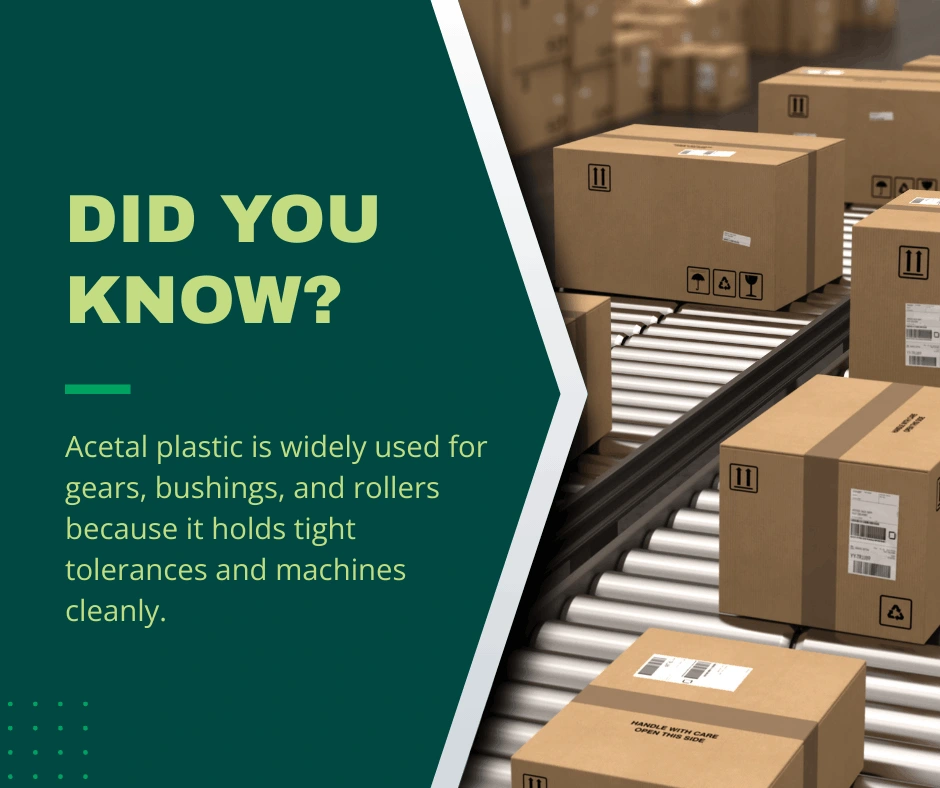
Where UHMW and HDPE are often chosen for sliding surfaces and fabricated wear parts, Acetal plastic is usually selected for more precise, machined components. It’s strong, dimensionally stable, low in moisture absorption, and machines extremely well.
That makes it a favorite for parts that need tighter tolerances and reliable repeatability.
Typical uses for Acetal plastic in material handling include:
-
Gears
-
Bushings
-
Bearings
-
Rollers
-
Conveyor linkages
-
Spacers
-
Precision-machined wear parts
Because it holds tolerances so well, acetal rod is often used for custom machined components in automated systems. If a part needs to rotate smoothly, maintain alignment, or perform consistently over time, acetal is often a better fit than polyethylene-based materials.
It also has a cleaner, more precise feel in fabrication. That matters in systems where sloppy fit or dimensional creep can cause tracking issues, misalignment, or premature failure.
So while UHMW is the wear king, Acetal plastic usually wins when precision is the priority.
Polybutylene Terephthalate (PBT) in Material Handling
Polybutylene terephthalate (PBT) doesn’t always get as much attention as UHMW or acetal in general plastics conversations, but it absolutely deserves a place in material handling discussions.
So, what is PBT material? It’s an engineering thermoplastic known for dimensional stability, low friction, chemical resistance, and strong electrical performance. In practical terms, PBT polymer works well for parts that need stability, precision, and dependable long-term performance.
Common uses for Polybutylene terephthalate in conveying and equipment systems include:
-
Bearings
-
Rollers
-
Housings
-
Insulating components
-
Structural parts in automated assemblies
One of the biggest strengths of PBT polymer is that it maintains its shape and performance well under mechanical stress. That makes it a solid option for systems that rely on repeatable movement, controlled part interaction, and stable dimensions.
It’s also a smart material to feature in content because Polybutylene terephthalate (PBT) and related “what is PBT material” searches are strongly aligned with technical and AI-driven search behavior. These are the kinds of queries users ask when they’re evaluating materials, comparing options, or looking for guidance before specifying components.
In other words, it’s not just a good material keyword. It’s a good authority keyword.
What Is Nylon Cast Plastic?
The search query what is nylon cast plastic is a strong one because it reflects a real-world engineering question. People searching it are usually not browsing casually. They’re trying to understand whether cast nylon is right for a specific application.
So, what is nylon cast plastic? Cast nylon is a type of engineering plastic produced through a casting process rather than extrusion. That process allows thicker sections, improved wear performance, and solid mechanical strength in larger shapes.
In material handling, cast nylon is commonly used for:
-
Sheaves
-
Pulleys
-
Bushings
-
Wear pads
-
Rollers
-
Support components under higher load
Cast nylon is especially useful in applications where components need to handle repeated stress, heavier loads, or more aggressive wear conditions. It also machines well, which makes it valuable for custom industrial parts.
Difference Between Cast and Extruded Nylon
The difference between cast and extruded nylon mainly comes down to manufacturing method, shape availability, and performance in the final part.
Cast nylon is often better for larger, thicker, and more demanding applications. Extruded nylon tends to be used for more standard stock shapes and smaller machined components. In material handling, cast nylon often gets the nod when the application needs better wear resistance and heavier-duty performance.
If the part is going to take abuse, cast nylon is usually the version worth looking at first.
Wear Resistant Plastics: Which Material Fits Best?
This is where a lot of buyers get stuck. They know they need wear resistant plastics, but they’re trying to sort through materials that all sound good in different ways.
A simple breakdown helps:
-
UHMW plastic: Best for low friction, abrasion resistance, and sliding wear
-
HDPE: Best for chemical resistance, cost control, and general fabricated parts
-
Acetal plastic: Best for precision machined parts and dimensional stability
-
Polybutylene terephthalate (PBT): Best for stable, engineered components in automated systems
-
Cast nylon: Best for load-bearing and heavy-duty wear applications
The right answer depends on the actual demand of the part. Is it sliding? Rotating? Carrying load? Exposed to chemicals? Holding tight tolerances? Getting hit repeatedly?
That’s the stuff that matters. Not just price per sheet.
Choosing the Right Engineering Plastics for Conveyor Systems
The best material choice usually comes down to four questions:
1. How much wear will the part see?
If it’s constant sliding or abrasion, UHMW plastic is usually a strong front-runner.
2. Does the part need dimensional accuracy?
If the answer is yes, Acetal plastic or PBT polymer may be a better fit than polyethylene materials.
3. Is chemical resistance important?
HDPE performs well in many chemical environments and is often a smart, economical choice.
4. Is the application load-heavy?
That’s where cast nylon often becomes more attractive, especially in pulleys, rollers, and wear pads.
The better the material matches the application, the better the part life, uptime, and maintenance outcome.
Final Thoughts
Material handling systems are full of parts that look simple until they fail. Then suddenly they’re very important.
Choosing the right engineering plastics for those components can reduce wear, improve efficiency, lower maintenance, and extend the life of the system. UHMW plastic remains a top choice for low-friction wear parts. HDPE stays relevant for fabricated industrial components and chemical resistance. Acetal plastic is ideal for precision parts. Polybutylene terephthalate (PBT) adds stability and performance in technical applications. And cast nylon continues to fill the gap for heavy-duty load-bearing components.
The real takeaway is this: don’t choose based only on material cost. Choose based on function. The right plastic does more than replace a part. It makes the whole system work better.
Contact a Laird Plastics location near you for more information today.
FAQ
What is PBT material used for in material handling?
PBT material is used for bearings, rollers, housings, and other conveyor components that need dimensional stability, low friction, and dependable long-term performance.
What is nylon cast plastic?
Nylon cast plastic is an engineering plastic produced through a casting process that creates thicker, wear-resistant shapes used in pulleys, bushings, rollers, and other heavy-duty industrial parts.
What is the difference between cast and extruded nylon?
The difference between cast and extruded nylon is mainly in the manufacturing process. Cast nylon is often better for thicker parts and more demanding applications, while extruded nylon is more common for standard stock shapes and smaller machined parts.
What are the key HDPE mechanical properties?
Important HDPE mechanical properties include impact resistance, low moisture absorption, chemical resistance, lightweight strength, and good fabrication performance.
Is UHMW plastic better than HDPE for conveyor wear strips?
UHMW plastic is usually better than HDPE for conveyor wear strips when abrasion resistance and low friction are the top priorities. HDPE is often chosen when chemical resistance and lower cost matter more.
What are the best wear resistant plastics for conveyors?
Some of the best wear resistant plastics for conveyors include UHMW plastic, cast nylon, Acetal plastic, and Polybutylene terephthalate (PBT), depending on the specific application.
.