Underground Plastic Conduit and Utility Components
A Specifier's Guide to Long-Term Infrastructure Performance
Construction & Infrastructure
By B. Decker • Updated June 2026 • 12 min read
Underground plastic utility components include conduit, duct bank spacers, pull boxes, and manhole structures. Each must hold up against soil loading, groundwater chemistry, and decades of mechanical stress. HDPE and PVC are the two primary materials, and they are not interchangeable. Specifying the right one for your site conditions is what determines whether a system lasts 50 years or needs costly, disruptive replacement well before that.
This guide covers the full scope of underground plastic utility components, how to choose between HDPE and PVC, duct bank spacer configurations, chemical resistance, DOT and utility authority specifications, and what Laird can supply and fabricate for your project.
The Full Scope of Underground Plastic Utility Components
Specifiers often focus on conduit and not much else. But the complete underground utility system includes several plastic components. Each has its own load, chemistry, and installation requirements. Getting any one of them wrong can compromise the whole installation.
The primary components in a below-grade utility assembly are:
- Electrical conduit: Rigid or flexible tubing that routes and protects conductors. Underground installations use Schedule 40 or Schedule 80 PVC, HDPE, or RTRC depending on soil conditions, load requirements, and encasement method.
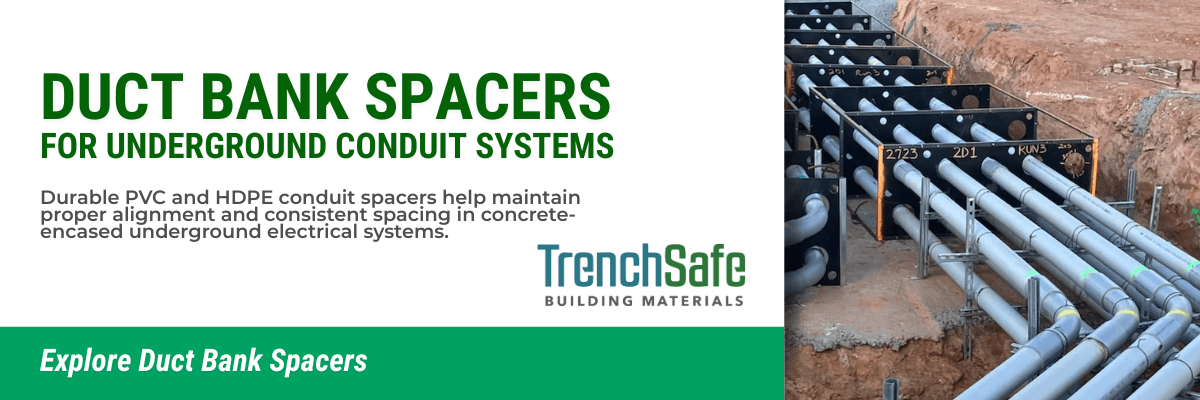
- Duct bank spacers: Polymer components that hold conduit at specified center-to-center spacing inside a concrete-encased duct bank. Correct spacing ensures adequate concrete coverage and meets thermal clearance requirements per NEC 310.60.
- Pull boxes and handhole enclosures: Below-grade access structures for conductor pulling, splicing, and maintenance. Material choice depends on traffic loading and depth. Common options are polymer concrete, HDPE, and fiberglass.
- Manhole structures: Full-access vaults at junction points and transition locations. Precast concrete is standard where vehicular loads are a factor. HDPE is used on corrosive or chemically aggressive sites.
- Transition and termination fittings: Couplings, reducers, and end caps that connect conduit to structures, equipment pads, and above-grade runs.
Each of these components appears in utility authority standard drawings. Many DOT and municipal agencies maintain approved product lists. Confirm material approvals before specifying.
HDPE vs. PVC Underground Conduit: Property and Lifecycle Comparison
Both HDPE and PVC are used for underground electrical conduit. They are not interchangeable. Each material suits different site conditions, installation methods, and service-life requirements.
PVC Electrical Conduit (Schedule 40 and Schedule 80)
Rigid PVC conduit is listed under NEMA TC 2 and UL 651. Schedule 40 covers standard below-grade installations. Schedule 80 has a thicker wall, making it the right choice for direct-buried runs without concrete encasement and for locations subject to higher mechanical stress.
PVC conduit installs in straight sections joined with solvent-weld couplings. It is dimensionally stable and resists most soils and groundwater. It costs less per linear foot than HDPE in most markets. On temperature: the NEC does not set a rated lower service temperature for rigid nonmetallic conduit, but PVC becomes more susceptible to impact damage as temperatures fall.
Handle and install with extra care below 40°F (4°C). At the upper end, PVC softens above 140°F (60°C). The NEC limits its use to locations where ambient temperature does not exceed 122°F (50°C) unless listed otherwise.
HDPE Conduit
HDPE conduit is covered by ASTM F2160. Its key advantage in underground utility work is flexibility. That flexibility is what makes it the standard choice for directional drilling (HDD), jack-and-bore, and sliplining rehabilitation projects.
HDPE conduit joins using manufacturer-identified fusion or mechanical methods. This produces a continuous run with no discrete coupling points. Note: the 2023 NEC (Section 353.48) prohibits heat fusion and butt fusion for HDPE conduit joints. Both methods leave an internal bead that can damage cable insulation during pull-through. Use electrofusion couplings or manufacturer-approved mechanical joints in jurisdictions that have adopted the 2023 NEC.
Continuous, joint-free runs eliminate the main failure modes seen in PVC systems in active or expansive soils: joint separation and misalignment. HDPE also absorbs ground movement and differential settlement without cracking.
Side-by-Side Comparison
| Property | PVC Schedule 40/80 | HDPE (ASTM F2160) |
|---|---|---|
| Standard | NEMA TC 2 / UL 651 | ASTM F2160 |
| Installation method | Solvent-weld, rigid sections | Electrofusion or mfr-approved mechanical joining (NEC 353.48; heat/butt fusion not permitted per 2023 NEC) |
| HDD / boring suitability | Not suitable | Preferred specification |
| Temperature range (service) | No rated lower limit (NEC); max ambient 122°F (50°C) per NEC 352.12 | Typically −40°F to 140°F (−40°C to 60°C); specialized grades to −94°F (−70°C) |
| Impact resistance | Moderate; brittle at low temps | High; ductile across range |
| Soil movement tolerance | Rigid; joint separation risk | Flexible; absorbs settlement |
| Chemical resistance | Excellent (most soils/groundwater) | Excellent (broad chemical range) |
| Concrete encasement | Standard for duct bank | Compatible; used in some bank configs |
| Typical cost/LF (relative) | Lower | Higher (offset by installation method) |
| Expected service life | 50+ years (encased, stable soil) | 50+ years (industry consensus) |
Service life figures are based on industry standards and material characterization data. Site conditions govern actual performance. Consult Laird's technical team for project-specific guidance.
The choice between PVC and HDPE usually comes down to installation method. Where open-cut with concrete encasement is feasible and soils are stable, Schedule 40 PVC is cost-effective and well-proven. Where trenchless installation is required, ground movement is a concern, or the project involves rehabilitating existing conduit, HDPE is the right call.
Duct Bank Spacer Configurations: Conduit Count, Spacing, and Encasement Design
A concrete-encased duct bank is the standard approach for multi-conduit utility installations in roadway corridors, utility easements, and campus environments. Spacers hold the conduit in a fixed array during the concrete pour and ensure the finished geometry matches the design drawing.
Spacing Requirements
NEC 310.60 and utility authority standard drawings govern center-to-center conduit spacing in a duct bank. For medium-voltage power conduit up to 4-inch trade size, 7.5 inches center-to-center is the common baseline. Larger conduits require additional clearance. Specific requirements vary by conductor size, voltage class, and jurisdiction. Thermal ampacity calculations depend on accurate spacing data. Deviations in the field directly affect allowable ampacity.
Spacers are made for standard conduit diameters, typically 2-inch through 6-inch trade size, and configured for the array geometry: two-wide, three-wide, or larger grids. The spacer body sets the horizontal dimension. Stacking clips or integrated risers handle the vertical tier spacing.
Encasement Concrete
Red-dyed concrete is standard on most utility installations. The color flags the duct bank location for future excavators. The mix is typically lean concrete at 2,000 to 3,000 psi compressive strength. Its job is encasement and position maintenance, not structural support. Specify a minimum of 3 inches of concrete cover over the outermost conduit, or whatever the utility authority requires if that's higher.
Spacer material must be compatible with the alkaline environment of fresh concrete. Standard utility spacers are made from virgin polypropylene or HDPE. Both are chemically inert in concrete and hold their dimensions through the cure period.
Related guide: For a detailed look at spacer selection, including sizing charts, array geometry, and approved configurations. See Laird's guide to duct bank spacers for underground electrical installations.
HDPE Fabrication for Utility Infrastructure
Standard conduit and spacer products cover most underground utility installations. Complex projects often need components that aren't in any catalog. That includes substations, large infrastructure crossings, utility tunnels, and pump stations.
HDPE is the material of choice for custom utility fabrication. It machines cleanly, welds reliably, and holds its chemical resistance across the full range of utility environments. Common fabricated items include:
- Custom spacers and support blocks: For non-standard conduit arrays, cable-in-air configurations in utility tunnels, and transition zones between bank geometries.
- Transition fittings: Reducers and adapters where conduit sizes change, or where HDPE meets PVC, steel, or RTRC sections.
- Structural supports and pipe saddles: For above-grade or vault-mounted runs where plastic conduit needs mechanical attachment to concrete or steel structure.
- Cable protection covers and trench dividers: Used in shared utility corridors to separate electric, telecommunications, and fiber runs by ownership or voltage class.
- Manhole and handhole frames: Custom HDPE entry collars and conduit termination plates for non-standard vault geometries.
Fabrication lead times need to be in the project schedule from the start. Standard catalog items ship from stock. Fabricated components require engineering review, material procurement, and production time. Get Laird's fabrication team involved during design development, not at bid time.
Chemical and Environmental Resistance: Soils, Groundwater, and Encasement Concrete
Underground plastic components face chemical exposure that above-grade installations don't. Soil and groundwater chemistry varies by region and site history. Brownfield sites can carry petroleum hydrocarbons, chlorinated solvents, and heavy metal leachates. Coastal and tidal sites bring chloride loading. Industrial corridors can put conduit in contact with concentrated acids, bases, or oxidizers in groundwater.
PVC Chemical Resistance
PVC resists most dilute acids, bases, and salt solutions. It does not resist concentrated ketones, esters, aromatic hydrocarbons, or chlorinated solvents. At contaminated sites where those compound classes appear in groundwater, PVC conduit can absorb the solvent, swell, and lose structural integrity over time. Get a geotechnical report with site-specific groundwater chemistry before specifying PVC on any industrial or brownfield site.
HDPE Chemical Resistance
HDPE has a wider chemical resistance range than PVC. It resists dilute and concentrated acids, bases, alcohols, and a broad range of hydrocarbons. It's not immune to everything. Concentrated oxidizing acids and halogenated solvents can affect HDPE at elevated temperatures. But at most contaminated utility sites, HDPE holds up better than PVC over the long term.
Concrete Encasement and Soil pH
Fresh Portland cement concrete is strongly alkaline. pH runs 12 to 13 during cure, dropping to 9 to 11 in mature concrete. Both PVC and HDPE are inert in this environment. Neither reacts with the alkaline pore solution. This is one reason plastic conduit is preferred over steel in concrete-encased installations. It needs no cathodic protection, no coating systems, and creates no galvanic interface at concrete boundaries.
Sulfate-bearing soils are a separate concern, not for the conduit, but for the concrete encasement. Where soil sulfate concentrations exceed 0.2% SO₄ by weight, or groundwater exceeds 150 ppm, specify sulfate-resistant cement for the duct bank mix. The conduit will be fine. The encasement is what needs protection.
| Exposure | PVC Sch 40/80 | HDPE |
|---|---|---|
| Dilute acids and bases | ✓ Resistant | ✓ Resistant |
| Salt solutions / chlorides | ✓ Resistant | ✓ Resistant |
| Petroleum hydrocarbons | ⚠ Site-specific | ✓ Generally resistant |
| Chlorinated solvents (e.g. TCE) | ✗ Not recommended | ⚠ Verify concentration |
| Alkaline soils / concrete | ✓ Resistant | ✓ Resistant |
| Concentrated oxidizing acids | ✗ Not resistant | ✗ Not resistant |
Resistance ratings are general guidance for underground service conditions. Verify against site-specific geotechnical and groundwater chemistry reports. Concentration, temperature, and exposure duration all affect performance.
DOT and Utility Authority Specifications: What Designers Need to Know
Underground utility work in roadway rights-of-way is governed by the permitting authority's standard specifications and drawings. Those documents control conduit material, wall thickness, burial depth, bedding and backfill, marking tape, concrete encasement specs, and approved product lists. Specifying materials without checking the applicable authority's standards is a reliable way to get substitutions or rejections at plan review.
Key Governing Documents
- NEC Article 352 — Rigid PVC conduit: permitted uses, installation requirements, and construction specifications.
- NEC Article 353 — HDPE conduit: permitted uses and installation requirements.
- NEC 310.60 — Ampacity tables for conductors rated 2001V and above. Governs thermal spacing requirements in duct banks.
- ASTM F2160 — Standard specification for solid-wall HDPE conduit based on controlled outside diameter.
- NEMA TC 2 — Dimensional and performance standard for electrical-grade rigid PVC conduit.
- State DOT standard specifications — Vary by state. Most follow AASHTO or APWA standards with local amendments. Always get the current edition for your project jurisdiction.
- Utility authority standards — Investor-owned utilities, municipal utilities, and telecom carriers all publish their own underground facility standards. These take precedence in their service territory and often name approved manufacturers or product numbers.
Approved Product Lists and Pre-Qualification
Many state DOTs and utility authorities maintain approved product lists (APLs) for conduit, spacers, and fittings. A product must be on the APL to appear in contract documents. If your preferred product isn't listed, the owner has to start a pre-qualification process. That takes time. Deal with it in early design, not at bid advertisement.
Laird's technical team can help determine whether materials in your project specification appear on relevant APLs and can connect your engineering team with manufacturer documentation for pre-qualification submissions.
Laird Plastics: Supply and Fabrication for Utility Infrastructure Projects
Laird Plastics stocks industrial-grade HDPE and PVC sheet, rod, and tube through a national distribution network. For utility infrastructure projects, we support work at multiple stages:
- Material supply: HDPE sheet for fabricated components, PVC sheet and rod for support and blocking, and custom-cut sections for field fabrication teams.
- Custom fabrication: Machined and welded HDPE components produced to engineer's drawings or shop drawings submitted for approval. Spacers, supports, transition blocks, cable protection covers.
- Technical support: Material selection guidance, chemical resistance review, and datasheet packages for submittal requirements.
- Project-scale procurement: Volume pricing and schedule coordination for large utility corridor projects that require consistent material supply across multiple delivery locations.
Contact Laird's industrial division to discuss your project. For fabrication inquiries, have drawings or dimensional sketches, quantity, and delivery schedule ready.
Specify with Confidence. Supply on Schedule.
Talk to Laird's industrial plastics team about your underground utility project. Material selection, fabrication, and project-scale supply.
Contact Laird IndustrialFrequently Asked Questions
What is the difference between Schedule 40 and Schedule 80 PVC conduit for underground installations?
Schedule 40 and Schedule 80 share the same outside diameter. The difference is wall thickness. Schedule 80 has a thicker wall, which means a smaller inside diameter and less conduit fill capacity, but greater crush resistance and impact strength. For direct-buried applications without concrete encasement, Schedule 80 is generally required. For concrete-encased duct bank installations, Schedule 40 is acceptable under most utility authority specifications and offers a cost advantage at scale.
Can HDPE conduit be used in a concrete-encased duct bank?
Yes. HDPE is chemically compatible with Portland cement concrete and is used in encased duct bank configurations. Some utility authorities prefer PVC for encased installations because it is more dimensionally rigid during the concrete pour. HDPE's flexibility means spacer attachment and the pour sequence need to be managed carefully to prevent conduit movement before the mix sets. Verify with the applicable utility authority's standard drawings before specifying HDPE in an encased bank application.
What conduit material is required for horizontal directional drilling (HDD)?
HDPE is the standard specification for HDD installations. Its flexibility allows it to be pulled in coiled lengths through the bored path. Continuous joints with no discrete coupling points eliminate the failure modes that would occur under the tensile and bending loads of the pull-back operation. Note: the 2023 NEC (Section 353.48) prohibits heat fusion and butt fusion for HDPE conduit joints. Verify the required joining method against the applicable code edition. Rigid PVC cannot withstand HDD installation stresses and is not a substitute in these applications.
How does spacing between conduits in a duct bank affect ampacity?
Spacing directly affects the thermal environment around each conduit. Conductors generate heat under load. When conduits are packed too tightly, that heat builds up, raising the ambient temperature inside each duct and reducing current-carrying capacity. NEC 310.60 provides ampacity tables based on conduit arrangement and soil thermal resistivity. Those tables assume specific spacing. If field-installed spacing is tighter than the design assumption, the ampacity calculation is no longer conservative.
What is the expected service life of HDPE and PVC underground conduit?
Both materials are designed for 50-year-plus service life when properly installed in a compatible chemical environment. Long-term aging data from material manufacturers supports that estimate. Actual performance depends on soil chemistry, burial conditions, installation quality, and whether the material was ever exposed to incompatible chemicals. Neither PVC nor HDPE is immune to mechanical damage during installation. Joint integrity and trench bedding quality are the most common contributors to early failure.
Do plastic conduits require cathodic protection underground?
No. Cathodic protection is a corrosion control measure for metallic structures: steel pipe, reinforcing steel, and metallic conduit. HDPE and PVC are non-conductive polymers. They don't corrode by electrochemical mechanisms and require no cathodic protection, coating systems, or isolation flanges. In corrosive soil environments, that's a meaningful lifecycle cost advantage over metallic systems that need ongoing corrosion monitoring and maintenance.
What information does Laird need to quote a fabricated HDPE utility component?
For a standard quote, provide dimensional drawings or sketches with critical tolerances noted, the material specification (HDPE grade and density if known), quantity, and required delivery date. For structural components, include the load case if the component needs to meet a specific strength requirement. If the material spec isn't finalized, Laird's team can suggest standard HDPE grades suited to the application.
Bottom Line
PVC and HDPE each have a place in underground utility work. The right choice depends on installation method, site chemistry, ground conditions, and the applicable authority's specifications. Get those factors clear before specifying. Engage Laird early when fabricated components are in scope — lead time is the variable that most often causes schedule problems on utility projects.
Related reading: Duct bank spacers for underground electrical installations • HDPE sheet and fabrication at Laird Plastics • Industrial plastics for construction and infrastructure

About the Author
B Decker is a Digital Content Specialist working with Laird Plastics, with five years of focused content production for the industrial plastics distribution sector and a decade of broader industrial-sector writing experience. B's work covers materials science explainers, fabrication and machining guidance, specification support, and application case studies across thermoplastics, engineering plastics, and composites.
For specification support, sample requests, or material certification documents, contact your local Laird Plastics location.
This article is for informational purposes only. Material selection, thickness specifications, code compliance, and installation requirements must follow project specifications, manufacturer datasheets, and applicable building codes and standards. Verify current standards, certifications, and material grades with the manufacturer and your design professional before specifying.
References & Standards
- NFPA 70 National Electrical Code, Article 352 — Rigid Polyvinyl Chloride Conduit: Type PVC. National Fire Protection Association.
- NFPA 70 National Electrical Code, Article 353 — High Density Polyethylene Conduit: Type HDPE. National Fire Protection Association.
- NFPA 70 National Electrical Code, Section 310.60 — Conductors Rated 2001 to 35,000 Volts. National Fire Protection Association.
- ASTM F2160 — Standard Specification for Solid Wall High Density Polyethylene (HDPE) Conduit Based on Controlled Outside Diameter (OD). ASTM International.
- NEMA TC 2 — Electrical Polyvinyl Chloride (PVC) Conduit. National Electrical Manufacturers Association.
- UL 651 — Standard for Schedule 40, 80, Type EB and A Rigid PVC Conduit and Fittings. Underwriters Laboratories.