
Corrugated Flute Sizes & Types Explained - Laird Plastics
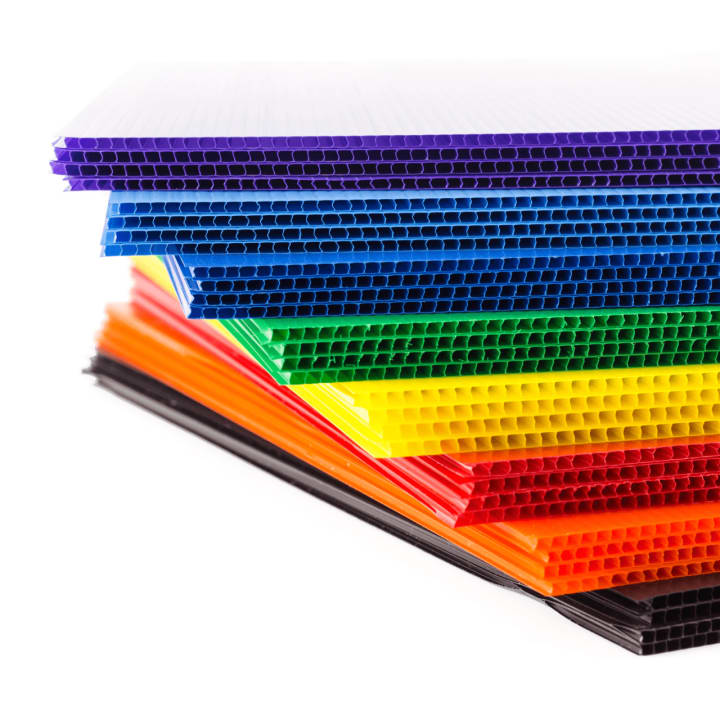
Corrugated fluted material is any sheet built from two flat facings separated by a row of hollow channels called flutes. In corrugated cardboard, a wavy paper medium is glued between two linerboards. In fluted plastic, extruded polypropylene ribs join two plastic skins. Either way, the flutes act as columns that add stiffness and crush resistance at very low weight.
By B. Decker • Updated November 2026 • Reviewed by the Laird Plastics Engineering Team • 10 min read
Flute size decides how a sheet behaves. Tall flutes cushion. Short, tightly packed flutes give a flatter face for printing and hold up better against punctures. The base material matters just as much. Paper corrugated is economical and widely recycled, but it weakens as it takes on moisture. Fluted polypropylene does not absorb water and can go back into service again and again.
Laird Plastics stocks both sides of this family. The corrugated and fluted sheet line includes B flute cardboard in 48" x 96" sheets, General Purpose fluted polypropylene in 4, 6, and 10 mm, and Primex Bubble-X co-extruded board. This guide covers the standard corrugated flute sizes, how plastic fluted sheet differs, and how to pick the right material for packaging, signage, and surface protection.
In this guide
- How corrugated flutes work
- Corrugated flute sizes chart
- A, B, C, E, and F flutes compared
- Single wall, double wall, and triple wall
- Where paper corrugated falls short
- Fluted plastic: how corrugated polypropylene differs
- Cardboard vs. fluted plastic comparison
- How to choose the right fluted material
- Working with flute direction
- Printing on corrugated and fluted sheet
- Frequently asked questions
How Corrugated Flutes Work
Paper corrugated board, which the Fibre Box Association also calls combined board, has two parts. Flat linerboard forms the outside faces. A fluted medium sits in the middle. Both are made from a heavy paper called containerboard, and the medium is formed into arches and glued to the liners.
Those arches do three jobs. Standing on end, they behave like columns and carry stacking loads. They hold the two liners apart, stiffening the board much like the web of an I-beam stiffens its flanges. And when the side of a box takes a hit, the arches flex and soak up some of the energy before it reaches the contents. The air trapped in the flutes also gives modest insulation against sudden temperature swings.
Spec tip: Count flutes instead of relying on a caliper reading. Board thickness shifts with liner weight and manufacturing conditions. Counting the flutes across one linear foot is the more reliable way to tell an A from a C or a B from an E.
Corrugated Flute Sizes Chart
U.S. corrugated uses letters to name flute profiles. The letters follow the order each profile was developed, not its size. A flute was the original. B flute came next for self-supporting canned goods. C flute arrived as an all-purpose profile, and E and F were added later for thinner retail packaging.
| Flute | Approx. flute height | Flutes per linear foot | Where it fits |
|---|---|---|---|
| A flute | 3/16 in. (4.8 mm) | About 33 | Maximum cushioning for fragile goods |
| B flute | 1/8 in. (3.2 mm) | About 47 | Inserts, displays, printed packaging, puncture resistance |
| C flute | 5/32 in. (4.0 mm) | About 38 to 39 | General shipping boxes; the most common box flute |
| E flute | 1/16 in. (1.6 mm) | About 90 | Retail cartons and mailers with high-quality print |
| F flute | 1/32 in. (0.8 mm) | About 125 | Small folding-carton style retail packaging |
Values are nominal. Profiles vary from mill to mill within the same letter, and combined board measures thicker than the flute height once the liners are added. Flute counts per the Fibre Box Association; A and F heights per Packaging Corporation of America.
A, B, C, E, and F Flutes Compared
A flute is the tallest standard profile and the oldest. Its big arches give the most cushioning and strong vertical compression, so it suits fragile items and loads that need padding. In practice, many converters now default to C flute for general shipping because it delivers similar performance with less paper.
B flute packs about 47 flutes into each foot. The denser, flatter face resists punctures, takes print cleanly, and die-cuts well. Those traits make it a common pick for inner packaging and retail displays. It is also the flute Laird Plastics stocks in sheet form: B flute cardboard in 48" x 96" sheets for shipping boxes, protective storage, custom printed packaging, and inner packaging.
C flute sits between A and B in height. It is the most common flute in corrugated boxes, balancing cushioning with stacking strength for everyday shipping cartons.
E and F flutes are the thin end of the range. E runs roughly 90 flutes per foot and F about 125. Their smooth faces print almost like paperboard, and the slim caliper saves shelf and shipping space. You see them on retail cartons, cosmetics, and small consumer-goods packaging.
A, B, C, E, and F are the most widely available profiles, though not the only ones. Mills also run other specialty and micro profiles for specific packaging lines.
Single Wall, Double Wall, and Triple Wall
Flute size is one variable. The number of fluted layers is the other.
- Single face: one medium glued to one liner, with the flutes exposed on one side.
- Single wall: one medium between two liners. This is the construction behind most boxes.
- Double wall: two mediums and three liners. A common pairing puts B flute over C flute, often written as BC flute.
- Triple wall: three mediums and four liners, used for heavy industrial and bulk shipments.
Where Paper Corrugated Falls Short
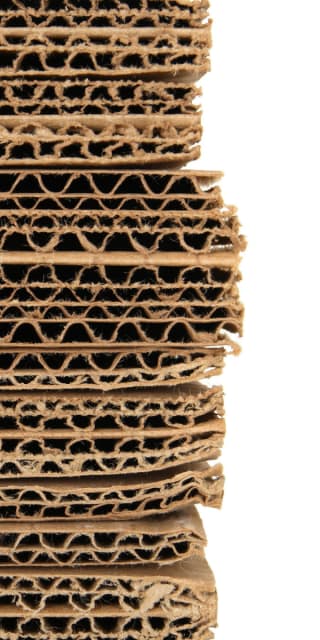 Corrugated fiberboard is a paper product, and paper fibers pull moisture out of the air. As the fibers soften and the starch adhesive weakens, the flutes lose rigidity. Citing the Fibre Box Handbook, the National Motor Freight Traffic Association reports that stacking strength can fall by more than 60% when relative humidity climbs above 95%. Direct contact with water does even more damage.
For one-way shipments in a dry warehouse, that rarely matters. For cold storage, outdoor staging, washdown areas, or anything handled repeatedly, it is the main reason buyers move to fluted plastic.
Fluted Plastic: How Corrugated Polypropylene Differs
Corrugated plastic copies the same structural idea in a different material. Instead of gluing a formed paper medium between liners, manufacturers extrude polypropylene into a twin-wall profile: two flat skins joined by internal ribs that run the length of the sheet. The result is a multi-wall sheet with internal channels that deliver high stiffness at low weight.
Three practical differences stand out.
- It is sized in millimeters, not letters. Fluted polypropylene is specified by overall thickness. Laird's General Purpose fluted polypropylene comes in 4, 6, and 10 mm, in sheet sizes from 24" x 18" up to 60" x 120".
- It does not absorb water. Polypropylene is nonabsorbent, so a wet sheet keeps its strength and simply dries off. Laird's General Purpose fluted PP is listed as weather, moisture, and chemical resistant.
- It can be reused. Fluted PP holds up to repeated handling. It shows up in returnable totes, bins, and part dividers for kitting and closed-loop logistics, and as temporary wall and floor protection on construction jobsites.
The same material goes by several names: corrugated plastic, fluted polypropylene, twinwall PP, and corriboard. A few trade names have turned generic. In North America many people say "Coroplast," a brand of Coroplast, LLC. In Australia, "Corflute," made by Corex Plastics Australia, plays the same role, and UK buyers often say "Correx."
Co-extruded print board
For print-heavy work, Laird also carries Primex Bubble-X, a three-layer co-extruded polypropylene board with bi-directional strength. Both faces are corona treated with a smooth matte finish. It comes in white, 4 mm or 5 mm, in 48" x 96" sheets, and its listed uses include point-of-purchase displays, signage, transit totes, and wall and floor assemblies.
When to step up to twinwall polycarbonate
Fluted PP is built for short- to mid-term outdoor use. When a fluted sheet needs to stay outside for years or pass light through, polycarbonate is the next step. Laird's polycarbonate line includes multiwall panels, lightweight rigid sheets with internal webs for thermal efficiency and light diffusion. Twinwall PC is UV-stabilized for long-term glazing and fits greenhouses, skylights, and partitions.
Corrugated Cardboard vs. Fluted Plastic: Comparison
| Property | B flute cardboard | Fluted polypropylene | Twinwall polycarbonate |
|---|---|---|---|
| Base material | Paper containerboard | Polypropylene | Polycarbonate |
| How it is specified | Flute letter and wall count | Thickness in mm (about 2 to 10 mm) | Thickness in mm (about 4 to 16 mm) |
| Moisture | Absorbs moisture; loses strength in high humidity | Nonabsorbent; moisture and chemical resistant | Weatherable; UV-stabilized grades |
| Outdoor service | Not intended for outdoor exposure | Short- to mid-term | Long-term glazing |
| Reuse | Typically one-way, then recycled | Returnable totes, bins, dividers | Permanent installations |
| Recycling | Widely recycled | Recyclable where facilities accept PP (resin code 5) | Recyclable in appropriate streams |
| Best for | Shipping boxes, inner packaging, printed retail packaging | Signs, POP displays, returnable packaging, temporary surface protection | Greenhouses, skylights, partitions, architectural panels |
| Laird stock sizes | 48" x 96" | 24" x 18", 48" x 96", 50" x 100", 60" x 120" | Ask your local branch |
How to Choose the Right Fluted Material
Start with the environment, then narrow down to a flute or caliper.
- One-way shipment or an indoor display that gets thrown away? Corrugated cardboard is the right call. B flute gives a clean print face; C flute or double wall carries heavier stacking loads.
- Going to get wet, sit in a cooler, or ride outside? Move to fluted polypropylene.
- Used dozens of times in a closed loop? Fluted PP is the material for returnable totes, bins, and part dividers.
- A printed sign? 4 mm and 6 mm are the common calipers for yard signs, wayfinding, and event graphics.
- Has to last outdoors for years or let light through? Specify twinwall polycarbonate.
Working With Flute Direction
On fluted plastic, flute direction affects nearly every fabrication step. These points come from Coroplast's conversion guidelines and apply to most twin-wall sheet:
- Read the size callout carefully. Coroplast lists the across-flute dimension first and the flute length second.
- Crease along the flutes when you can. Across-flute creases are harder and need a wider creasing rule, and the two skins must crush together to form a clean fold.
- Cut all the way through. Unlike paperboard, twin-wall plastic has to be cut fully through, so a sharp beveled rule makes a real difference.
- Square the sheet first. Edges running along the flutes are parallel, but cross-flute edges can be up to 3/8" out of square. Guide sheets into equipment by the parallel edges.
- Convert at room temperature. Cold sheets can pick up condensation that hurts ink adhesion, and dust or fingerprints cause the same problem.
Laird Plastics offers cut-to-size service and CNC routing, and can convert fluted polypropylene into totes, bins, and dividers with scoring, riveting, and custom inserts.
Printing on Corrugated and Fluted Sheet
Paper corrugated is printed mainly by flexography. Smithers research reported by the Flexographic Technical Association put flexo at 79.6% of corrugated print output by volume in 2020. Digital inkjet has grown for short runs and versioned graphics, and litho-laminated facings handle photo-quality retail boxes. B flute's dense face is a good fit for printed graphics.
Fluted polypropylene takes a different approach. Polyolefin surfaces are nonabsorbent and resist ink adhesion, so print grades are typically corona treated on both faces. Most fluted PP runs on screen, UV inkjet, and latex equipment. Check surface treatment by SKU before a production run, and use inks formulated for polyolefins. For more on sign substrates, see choosing the right rigid substrates.
Need fluted sheet cut to size?
Laird Plastics stocks B flute cardboard, fluted polypropylene in 4, 6, and 10 mm, and Primex Bubble-X board. Talk with your local branch about stock, cut-to-size parts, and converting.
Frequently Asked Questions
What are the standard corrugated flute sizes?
The five standard U.S. flute sizes are A, B, C, E, and F. A is the tallest at about 3/16 inch with roughly 33 flutes per foot, and F is the thinnest at about 1/32 inch with roughly 125 flutes per foot.
Why are corrugated flutes lettered out of size order?
The letters track the order the profiles were developed. A came first, then B, then C, so C ends up between A and B in height.
What is the difference between B flute and C flute?
B flute is shorter and denser, about 1/8 inch with 47 flutes per foot, giving a flatter print face and better puncture resistance. C flute is about 5/32 inch with 38 to 39 flutes per foot and offers more cushioning and stacking strength for shipping boxes.
Which corrugated flute is the strongest?
It depends on the load. A and C flutes give more cushioning and vertical compression strength, B resists punctures better, and double-wall board such as BC flute handles heavier loads than single-wall options.
Is corrugated plastic the same as corrugated cardboard?
No. Both use a fluted structure, but cardboard is paper and corrugated plastic is extruded polypropylene that does not absorb water, resists many chemicals, and can be reused.
What thickness of corrugated plastic is used for yard signs?
4 mm and 6 mm are the common calipers for yard signs and printed sign panels. Laird Plastics stocks General Purpose fluted polypropylene in 4, 6, and 10 mm.
What is Corflute?
Corflute is a brand of corrugated polypropylene sheet made by Corex Plastics Australia, and Australians use the name for corrugated plastic in general. North American buyers use "Coroplast" the same way.
Is fluted polypropylene recyclable?
Yes, where local facilities accept it. Polypropylene carries resin identification code 5, and Primex Bubble-X is listed as 100% recyclable.
Can Laird Plastics cut corrugated or fluted sheet to size?
Yes. Laird Plastics offers cut-to-size service and CNC routing, and can convert fluted polypropylene into totes, bins, and dividers. Contact your local branch for a quote.
Bottom Line
Flute letters describe paper corrugated: A for cushioning, B for print and puncture resistance, C for everyday shipping, and E and F for thin retail packaging. Once moisture, reuse, or outdoor exposure enters the picture, fluted polypropylene takes over, specified by millimeter thickness instead of a letter. Twinwall polycarbonate covers long-term outdoor and light-transmitting jobs. Match the material to the environment first, then choose the flute or caliper.
Related reading
- Corrugated plastic applications, cutting, and printing tips
- What is polypropylene (PP) plastic?
- Plastic material for yard signs and vinyl banners
- Plastics used in signage
- Choosing the right rigid substrates

About the Author
B Decker, Digital Content Specialist
B Decker is a Digital Content Specialist working with Laird Plastics, with five years of focused content production for the industrial plastics distribution sector and a decade of broader industrial-sector writing experience. B's work covers materials science explainers, fabrication and machining guidance, specification support, and application case studies across thermoplastics, engineering plastics, and composites.
For specification support, sample requests, or material certification documents, contact your local Laird Plastics location.
Specifications in this article are nominal values for general guidance. Confirm grade, thickness, and suitability for your application with your local Laird Plastics branch. Coroplast® is a registered trademark of Coroplast, LLC. Corflute® is a registered trademark of Corex Plastics Australia. Bubble-X™ is a trademark of Primex. Other trademarks belong to their respective owners. Laird Plastics® is a registered trademark owned by Laird Technologies, Inc. and is used herein pursuant to a license.
Sources
- Fibre Box Association, "What is Corrugated?"
- Packaging Corporation of America, "Profiles with a Purpose"
- NMFTA, "Packaging in the Summertime: How Summer Humidity Destroys Paper and Corrugated Packaging" (2026)
- Coroplast, "General Conversion Information"
- Flexographic Technical Association, "Smithers Research Deems Flexography's Market Share 'Lucrative'" (2021)