
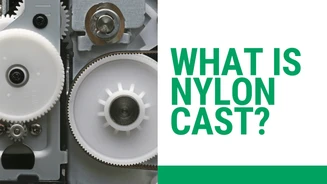
What Is Cast Nylon? Properties, Uses and Limits
Material Guides
By B. Decker • Updated October 2026 • Laird Plastics Engineering Team • 9 min read
Cast nylon is nylon 6 (PA 6) made by pouring liquid caprolactam into a mold, where it polymerizes into solid stock. The process produces large rods, tubes, plates, and custom shapes with strong wear resistance. Machine shops use cast nylon for gears, bushings, wear pads, sheaves, and rollers.
Cast nylon shows up in gears, bushings, wear pads, sheaves, and rollers. Buyers still mix it up with extruded nylon. The two share a name and a family, but they form in different ways and usually use different polymers. This guide covers how cast nylon is made, what its properties look like on real datasheets, where it works, and where it does not.
Cast Nylon Facts at a Glance
Every number in this section comes from a published producer, supplier, or regulatory source. Start here, then read the sections below for context.
- Polymer: Nylon 6 (PA 6), made from caprolactam.
- Process: Liquid caprolactam polymerizes inside a mold.
- Origin: Paul Schlack of IG Farben developed the caprolactam route to nylon 6 in 1938.
- Commercial history: Cast nylon 6 reached commercial production in the 1960s.
- Size range: Mitsubishi Chemical Advanced Materials reports cast parts from under 1 lb to over 1,000 lb, discs over six feet across, and gear rings up to 96 inches.
- Typical tensile strength: 10,000 to 13,500 psi, depending on producer and grade.
- Water absorption: Up to 7.0% at saturation on one supplier table.
- Flammability: Combustible. One supplier table lists UL 94 HB.
Typical properties of cast nylon 6
| Property | Unfilled cast nylon 6 (Professional Plastics) | Cast Nylons Limited 6PA ranges |
|---|---|---|
| Density | 1.15 g/cm³ | Not listed |
| Tensile strength | 12,000 psi | 10,000–13,500 psi |
| Elongation | 20% | 20–55% |
| Tensile modulus | 400,000 psi | Not listed |
| Flexural strength | 16,000 psi | Not listed |
| Compressive strength | 15,000 psi | Not listed |
| Hardness | Rockwell R115 | Not listed |
| Notched Izod impact | 0.4 ft-lb/in | 1.5–2.5 ft-lb/in |
| Melting point | 420°F (215°C) | 430 ± 10°F |
| Heat deflection at 264 psi | 200°F (93°C) | 200–300°F |
| Service temperature | 200°F (93°C) maximum operating | 230°F continuous, 330°F intermittent |
| Water absorption, 24 hours | 0.3% | 0.5–0.6% |
| Water absorption, saturation | 7.0% | 4.0–6.0% |
| Thermal expansion | 3.5 × 10⁻⁵ in/in/°F | Not listed |
| Flammability | UL 94 HB | Not listed |
Values are typical at 73°F. They are not specifications. The Professional Plastics sheet lists ASTM D638 for tensile strength, D256 for notched Izod impact, D570 for water absorption, D648 for heat deflection, and D3418 for melting point. The Cast Nylons Limited figures come from its published capabilities brochure.
Why two columns: Producers publish different values for the same material class. Impact strength, service temperature, and melting point all differ in this table. Use it for orientation. Get the datasheet for the exact grade you plan to buy.
How Cast Nylon Is Made
Cast nylon starts as a liquid. Producers pour caprolactam into a mold, where it polymerizes in place by anionic polymerization into solid nylon 6. FDA's nylon resin regulation, 21 CFR 177.1500, defines nylon 6 as the polymer of epsilon-caprolactam.
The chemistry is older than the product. Paul Schlack of IG Farben polymerized caprolactam in 1938, according to the Deutsche Biographie. Cast nylon 6 reached commercial production in the 1960s, as Mitsubishi Chemical Advanced Materials describes it.
Near-net-shape castings
A near-net-shape casting is poured close to its final geometry. The machinist removes less material. Cast Nylons Limited pours sheaves and other parts this way. Laird's nylon cast and extruded category points to cast nylon for near-net custom shapes.
Mitsubishi describes cast nylon as the middle path between machining standard stock and investing in injection molds. That is the main reason machine shops reach for it.
Cast Nylon vs Extruded Nylon
The short version: cast nylon is nylon 6 formed in a mold. Extruded nylon is usually nylon 6/6 pushed through a die.
Nylon 6 and nylon 6/6 are both polyamides
Both are polyamides and both are polymers. The difference is the chemistry. Nylon 6 comes from one monomer, caprolactam. Nylon 6/6 (nylon 66) comes from hexamethylenediamine and adipic acid. Nylon 6/6 melts higher. 21 CFR 177.1500 lists a melting range of 392 to 446°F for nylon 6 resin and 475 to 495°F for nylon 66 resin.
| Factor | Cast nylon | Extruded nylon |
|---|---|---|
| Typical polymer | Nylon 6 (PA 6) | Usually nylon 6/6 (PA 66) |
| How it forms | Liquid caprolactam polymerizes in a mold | Melted resin is forced through a die |
| Resin melting range (21 CFR 177.1500) | 392–446°F (nylon 6) | 475–495°F (nylon 66) |
| Best fit by size | Large sections and near-net custom shapes | Smaller diameters |
| Stock form | Rods, tubes, plates, custom castings. Tubes ship oversize for finishing | Standard stock sizes |
| Temperature capability | Set by the datasheet for the grade | Type 6/6 tends to run slightly higher |
Emco Industrial Plastics says in its nylon FAQ that cast nylon is more ductile and cost-effective in large sections. It also says type 6/6 tends to have slightly higher temperature capability. Treat both as general tendencies. The datasheet for the grade decides.
Rule of thumb: Pick cast nylon when the part is large or the shape is custom. Pick extruded nylon when a standard small-diameter size covers the job.
Cast Nylon Grades and Fillers
Producers modify base cast nylon 6 to change friction, heat resistance, or load behavior. Grade names vary by producer. Confirm the exact grade code on the datasheet.
| Grade type | What changes |
|---|---|
| Natural (unfilled) | The base nylon 6. The property table above describes this grade. |
| Heat-stabilized | Raises the temperature rating. One producer rates its blue XHA grade at 250°F continuous and 350°F intermittent, against 230°F and 330°F for its standard 6PA. |
| Oil-filled | Builds lubricant into the material for sliding wear surfaces. Cast Nylons Limited introduced the first oil-filled cast nylon, NYLOIL. |
| Molybdenum disulfide (MoS₂) | Adds a solid lubricant. One producer combines MoS₂ with oil in its MDX grade. |
| Metal-core billets | Cast nylon formed with a metal core. One producer sells these billets for gears, rollers, and sprockets. |
| Food-contact | Specific grades tested to 21 CFR 177.1500. See the food-contact section below. |
Availability varies by grade and size. Ask your local Laird location what is in stock.
Where Cast Nylon Is Used
Cast nylon fits parts that slide, roll, or take wear. Mitsubishi lists wear pads, sheaves, outrigger feet, trackplates, rollers, bushings, and gears among its applications.
- Gears and gear rings. Cast gear rings reach 96 inches on Mitsubishi's published range.
- Bushings and wear pads. Machine shops turn and mill them from cast rod, tube, and plate.
- Sheaves and rollers. Producers cast sheaves directly in near-net shape.
- Outrigger feet and trackplates. Both appear on Mitsubishi's application list.
- Food processing and packaging machinery. Gears and wear parts here need food-contact grades.
Machine shops are the main buyers. See which plastics machine shops use and browse Laird's machine shop plastics page. For food plant parts, start with Laird's food and beverage plastics.
Limits of Cast Nylon
Nylon fits many parts and misses on others. Check these limits before you specify it.
- Moisture. Nylon absorbs water. One supplier table lists 0.3% in 24 hours and 7.0% at saturation. Another lists 4.0% to 6.0% at saturation. Absorbed water changes part dimensions, so plan for it on tight-tolerance parts. Compare acetal when dimensional stability matters most.
- Heat. Maximum operating temperature is 200°F on one sheet and 230°F continuous on another. Heat deflection at 264 psi is 200°F for the unfilled grade on the first sheet. Heat-stabilized grades go higher.
- Impact values vary. Notched Izod runs 0.4 ft-lb/in on one sheet and 1.5 to 2.5 ft-lb/in on another. Get the datasheet for your grade. Radius internal corners on parts that take shock.
- Chemicals. Nylon handles fuels and lubricants well. Phenols, strong acids, and oxidizing agents attack it. Check a resistance chart for your exact media and temperature.
- Flammability. Nylon is combustible. One supplier table lists cast nylon 6 at UL 94 HB. Request the rating for your grade when a flame rating matters.
Food-Contact Cast Nylon
Not every cast nylon is food safe. Only grades with compliance documentation qualify. FDA regulates nylon resins for food contact under 21 CFR 177.1500.
Cast Nylons Limited states that named grades (6PA Natural, 6PA FG, and NYLOIL FG) were third-party tested to that regulation. The maker of the finished article must still evaluate its own article. Laird's extruded nylon rod page lists natural grade compliance with FDA, USDA, NSF, and 3A-Dairy requirements. Ask for the compliance letter on the exact grade before you order for a food plant.
How to Specify and Order Cast Nylon
- Name the material: cast nylon 6 or extruded nylon 6/6.
- Pick the grade: natural, heat-stabilized, oil-filled, MoS₂, or food-contact.
- State the form and size. Emco notes that cast tubes are cast with excess outside diameter, inside diameter, and length for machining, so allow for finish cuts.
- List operating temperature, moisture exposure, load, and chemicals.
- Ask for the datasheet and any compliance letters for the grade.
Laird lists nylon in its nylon cast and extruded category. Its engineering plastics page says cut-to-size and custom fabrication are available nationwide.
Need cast nylon for a gear, bushing, or wear pad?
Send the size, grade, and operating conditions. Your local Laird Plastics location will review the request.
Contact Laird PlasticsFrequently Asked Questions
What is cast nylon?
Cast nylon is nylon 6 formed by polymerizing liquid caprolactam inside a mold. Producers supply it as rods, tubes, plates, and near-net-shape castings.
Is cast nylon the same as nylon 6?
Yes. Cast nylon is nylon 6 made by the casting process. Extruded nylon is usually nylon 6/6, a different polyamide made from hexamethylenediamine and adipic acid.
What is the difference between cast and extruded nylon?
Cast nylon polymerizes in a mold and is usually nylon 6. Extruded nylon is melted resin forced through a die and is usually nylon 6/6. Cast stock suits large sections and custom shapes. Extruded stock suits smaller diameters.
Does cast nylon absorb water?
Yes. One supplier lists 0.3% absorption at 24 hours and 7.0% at saturation. Another lists 4.0% to 6.0% at saturation. Absorbed water changes part dimensions.
What temperature can cast nylon handle?
Published limits run from a 200°F maximum operating temperature to 230°F continuous service, depending on the producer. One producer rates its heat-stabilized grade at 250°F continuous and 350°F intermittent. Check the datasheet for your grade.
Is cast nylon food safe?
Only specific grades are. The FDA regulates nylon resins for food contact under 21 CFR 177.1500. Ask the supplier for compliance documentation on the exact grade before you order.
Can you machine cast nylon?
Yes. Cast nylon is a machining material, and cast tubes ship with extra outside diameter, inside diameter, and length for finish machining. Machine shops make gears, bushings, and wear parts from it.
Does nylon burn?
Yes. Nylon is combustible. One supplier table lists cast nylon 6 at UL 94 HB. Request the flammability rating for your grade when a flame rating matters.
What is oil-filled cast nylon?
Oil-filled cast nylon carries lubricant inside the material for sliding wear surfaces. Cast Nylons Limited introduced the first oil-filled cast nylon, NYLOIL.
Bottom Line
Cast nylon is nylon 6 formed in a mold. It fits large parts, custom shapes, and wear components that machine shops finish to size. Extruded nylon 6/6 fits smaller diameters and tends to run slightly hotter. Check moisture, temperature, and food-contact needs before you choose. Read the datasheet for the exact grade.
Related reading

About the Author
B Decker is a Digital Content Specialist working with Laird Plastics, with five years of focused content production for the industrial plastics distribution sector and a decade of broader industrial-sector writing experience. B's work covers materials science explainers, fabrication and machining guidance, specification support, and application case studies across thermoplastics, engineering plastics, and composites.
For specification support, sample requests, or material certification documents, contact your local Laird Plastics location.
This article is for informational purposes only. Material selection, thickness specifications, code compliance, and installation requirements must follow project specifications, manufacturer datasheets, and applicable building codes and standards. Verify current standards, certifications, and material grades with the manufacturer and your design professional before specifying.
References & Standards
- 21 CFR 177.1500: Nylon resins. Code of Federal Regulations, Title 21, U.S. Food and Drug Administration.
- ASTM D638: Standard Test Method for Tensile Properties of Plastics. ASTM International.
- ASTM D256: Standard Test Methods for Determining the Izod Pendulum Impact Resistance of Plastics. ASTM International.
- ASTM D570: Standard Test Method for Water Absorption of Plastics. ASTM International.
- ASTM D648: Standard Test Method for Deflection Temperature of Plastics Under Flexural Load in the Edgewise Position. ASTM International.
- ASTM D3418: Standard Test Method for Transition Temperatures and Enthalpies of Fusion and Crystallization of Polymers by Differential Scanning Calorimetry. ASTM International.
- UL 94: Tests for Flammability of Plastic Materials for Parts in Devices and Appliances. UL Standards & Engagement.
- Nylon typical properties. Professional Plastics.
- General capabilities brochure. Cast Nylons Limited (hosted by Polymershapes).
- Product spotlight: cast nylon 6. Mitsubishi Chemical Advanced Materials.
- Nylon FAQs. Emco Industrial Plastics.
- Schlack, Paul. Deutsche Biographie.